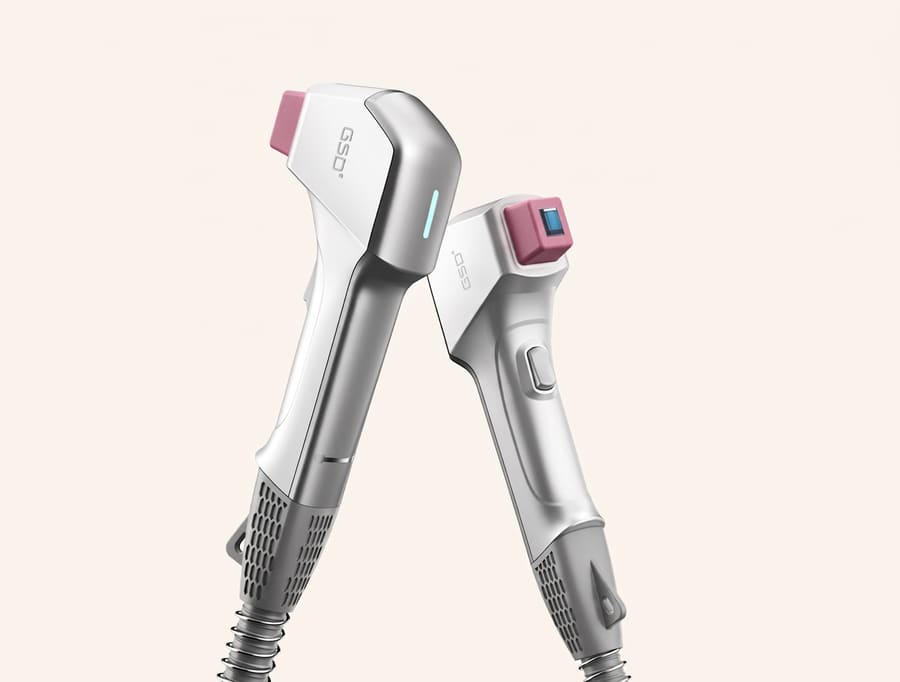
Coolite Evo Fibre-Coupled Diode Laser by GSDApproximately 15–60 minutes depending on treatment area
A fibre-coupled diode-laser platform for unwanted pigmented terminal hair on underarms, legs, arms, bikini area, back and selected facial areas, with contact cooling built in to protect the skin surface and improve comfort. Melanin in the hair absorbs the laser energy, and because only a proportion of follicles are sufficiently susceptible during each session, treatments are repeated across multiple hair cycles, usually six to eight initial sessions. Results depend on hair colour, calibre, body site, hormones, skin type and recent sun exposure, white, grey, red or very blonde hair responds poorly. It's often suitable for Asian or darker skin after appropriate assessment and parameter selection, since pigmentation changes or burns remain possible, especially on tanned or inflamed skin.
Purposeful Combinations
Coolite + medical assessment
Evaluate persistent facial hair and possible androgen excess, including PCOS when clinically indicated.
Coolite + skin care
Barrier support, sun protection and management of shaving-related irritation.
Coolite + pigment management
Where post-inflammatory marks coexist, stabilise the skin first and consider later MIIN Nd:YAG or other targeted pigment management on a separate plan.
Coolite + folliculitis plan
Assess recurrent ingrown hair or folliculitis; laser may help reduce the hair trigger but is not a substitute for treatment of active infection.
Commonly Asked
Coolite Evo is a fibre-coupled diode-laser platform by GSD used primarily for long-term hair reduction.
The more accurate term is long-term hair reduction rather than guaranteed removal of every hair. Some follicles may recover, new hair can develop, and periodic maintenance may be needed.
Hair grows in cycles. Laser is most effective when hairs are in an appropriate active-growth phase, so repeated sessions are needed.
A course of approximately six to eight sessions is common, but the exact plan varies with hair, skin and hormonal factors, especially facial or hormonally influenced hair. Body intervals are commonly around 6–8 weeks, with timing following actual regrowth.
Patients may experience heat, snapping or prickling sensations. Contact cooling may improve comfort, but treatment is not guaranteed painless.
Laser relies on pigment within the hair. Very light, white, grey or red hair generally responds poorly to conventional laser hair-reduction technology.
Often yes, after appropriate assessment and parameter selection. Pigmentation changes or burns remain possible, especially on tanned or inflamed skin, and alternative wavelengths may be considered where appropriate.
Patients are commonly advised to shave rather than wax or pluck before treatment, usually avoiding waxing or plucking for around four weeks beforehand. Follow the clinic's specific preparation instructions.
Waxing and plucking remove hair from the follicle and can interfere with laser targeting, so they are generally avoided during a treatment course, shaving is generally preferred instead.
Usually minimal, though temporary redness, warmth or follicular swelling may occur. Most patients resume routine activities quickly, but post-care restrictions depend on the treated skin.
Very fine or lightly pigmented facial hair responds unpredictably and may carry a risk of paradoxical increased hair growth, so assessment is important first.
Burns, blisters, darker or lighter pigmentation, folliculitis, eye injury and, rarely, scarring or paradoxical increased hair growth can occur, particularly on selected facial areas.
Elective laser hair reduction is generally deferred in pregnancy because safety evidence is limited.
Inform the clinic. Recent tanning increases epidermal injury risk and may require postponement, we don't treat recently tanned skin without reassessment.
Reviewed by Dr. Dinesh Kanasen (MMC 43953) · Last updated 22 October 2026