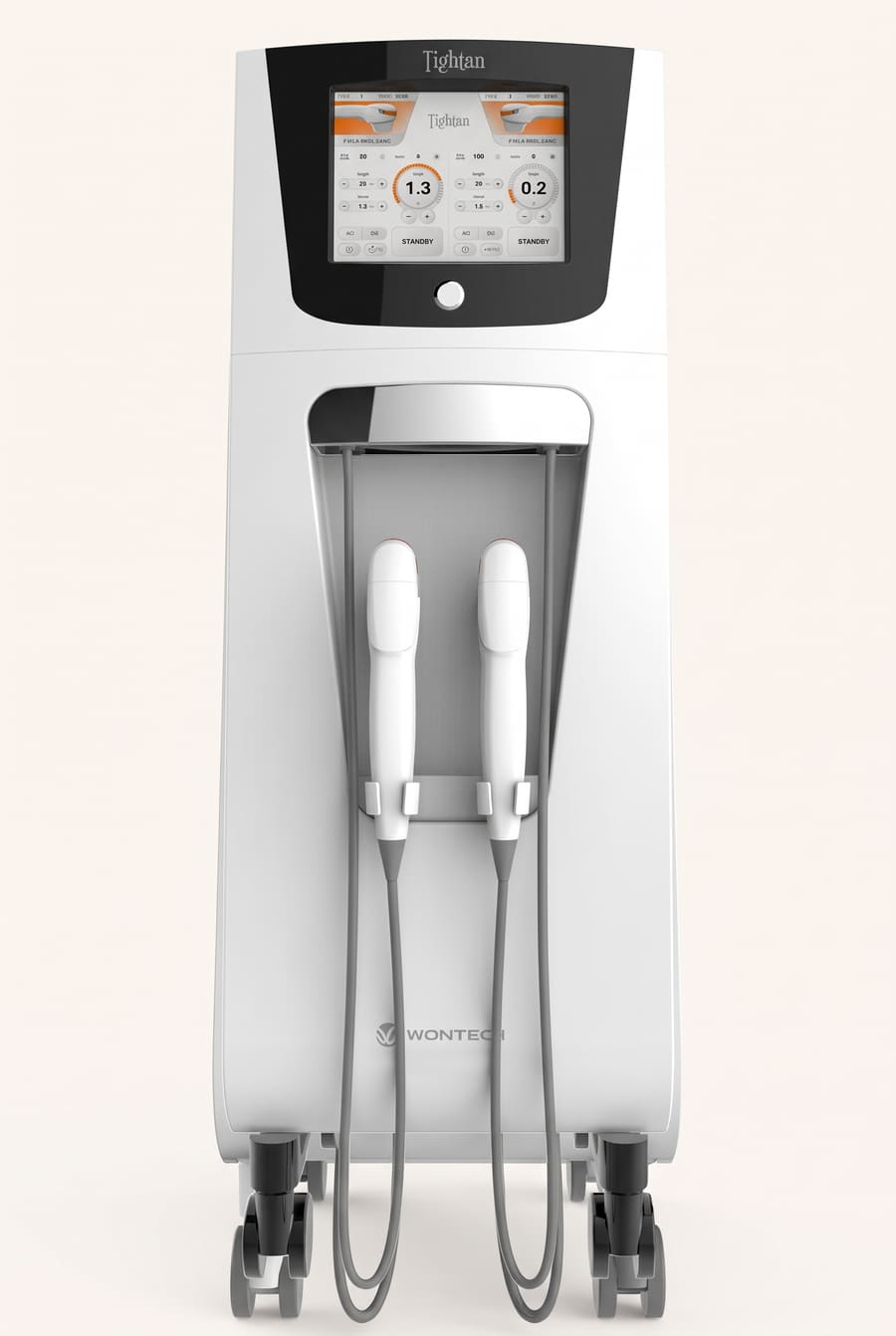
Tightan II HIFU by WONTECH, South KoreaVaries by assessed area and clinic protocol; confirm at consultation
Tightan II is a focused-ultrasound platform by WONTECH, South Korea that delivers energy to selected tissue depths without skin incisions, including the SMAS layer addressed during a surgical facelift, treatment is planned around facial anatomy, concerns and the actual cartridges available at the clinic. Dr.D considers it for appropriate patients with early-to-moderate facial laxity, softer jawline definition and selected areas beneath the chin or around the lower face, it is not a replacement for surgery in substantial skin excess. The objective is gradual support of firmness and more defined-looking facial contours, improvement can be subtle and varies with baseline laxity, age, anatomy and treatment technique, a lifted or slimmer face is not guaranteed. Beyond anti-ageing use, it's also considered for facial slimming, jawline definition and V-shape contouring in younger patients.
Purposeful Combinations
Sunny RF
For a separate radiofrequency-based skin-firming objective. Decide energy sequence and recovery before combining.
Sylfirm X RF Microneedling
For selected skin quality, pores or scars. It acts differently and needs an individual skin assessment.
ADVATx Yellow Laser
For selected redness or acne-related marks; not a replacement for ultrasound firming.
Skin boosters / Juvelook
For selected hydration or skin-quality goals; assess timing and treatment depth.
Dermal fillers / toxin
For separately assessed volume, contour or muscle-related concerns. Do not assume same-day treatment.
Commonly Asked
No. It is a non-surgical ultrasound treatment and cannot replace surgical correction of substantial excess skin.
Heat, tingling or discomfort may be felt, especially near bone. Comfort varies, tell your clinician about unexpected pain.
Its platform supports multiple cartridge and delivery formats, dot, linear and pen-format options by installed configuration. The doctor chooses among the clinic's installed options based on anatomy; more formats do not prove greater clinical effectiveness.
Facial contours such as the jawline and selected submental or neck areas may be considered after anatomical assessment.
Focused ultrasound does not rely on pigment as a target, but suitability still depends on skin and tissue examination and medical history.
It may support definition where laxity contributes. It is not a guaranteed fat-reduction treatment; fat distribution and skin quality need separate assessment.
Assess over weeks to around three months rather than expecting an immediate transformation.
Not necessarily. A single session is commonly marketed for facial HIFU, followed by review of response over approximately 2–3 months. Your doctor reviews your response and goals before advising if another treatment is worthwhile.
No. Results vary and ageing continues; no permanent lift can be promised.
Often yes, although temporary tenderness, redness or swelling may occur.
Possibly, for different objectives. The doctor decides the safe sequence and timing.
Follow clinic-specific aftercare, avoid unnecessarily irritating treated skin while tender, and maintain sensible skincare and sun protection. Seek review for blisters, significant worsening pain, new weakness or persistent altered sensation.
Tell your doctor about pregnancy, implanted devices or materials, previous facial procedures, fillers, infection, unusual facial sensation, nerve conditions, poor healing and any significant medical history. The clinician must check local instructions for use and treatment exclusions.
While HIFU is well known as an anti-ageing treatment, it's also chosen by younger patients who want a more defined, V-shaped facial contour or simply wish to maintain firmness before visible sagging develops. Suitability depends on your skin and goals rather than age alone, and your doctor can advise whether it fits your objective.
HIFU can be focused to treat the SMAS (superficial musculoaponeurotic system), the same supportive tissue layer that surgeons lift and tighten during a facelift. This is one of the reasons it's positioned as a non-surgical alternative, though the degree of lift achievable is naturally more modest than surgery.
HIFU's thermal energy can support mild reduction of submental fat alongside its tightening effect, which may contribute to a slimmer under-chin area and more defined jawline over time. It works gradually and isn't a substitute for a dedicated fat-reduction treatment if significant fullness is the primary concern, your doctor can advise on the best approach.
HIFU technology can also be applied to areas such as the abdomen, arms or thighs for skin tightening, and is sometimes discussed in relation to cellulite or stretch mark appearance. Body treatment typically uses different settings and cartridges from facial protocols, so this would need a separate assessment and isn't automatically part of a facial HIFU session.
When appropriately applied, HIFU may contribute to a subtle lift around the brow and a softer appearance of crow's feet as skin firms and collagen rebuilds. It's not typically the primary treatment for dark circles or under-eye bags, which usually have other underlying causes your doctor would assess separately.
Yes, the neck is one of the areas commonly treated with HIFU, and many patients see a gradual improvement in skin firmness and a reduction in the appearance of loose folds along the jawline and neck. As with the face, results build over weeks to months rather than appearing immediately.
HIFU's collagen-stimulating effect may offer some general improvement in skin texture, including a softer appearance of certain acne scars, but it isn't typically the first-line treatment for scarring. Options such as CO2 laser or Sylfirm X are usually more targeted for acne scars, and your doctor can advise which approach, or combination, suits your skin.
Many patients notice a gradual improvement in overall skin quality alongside tightening, including a smoother texture, refined pore appearance and a healthier-looking glow, as collagen and circulation in the treated area improve. These changes tend to appear alongside the main lifting effect rather than as a separate step.
HIFU technology does have intimate-health applications, such as non-surgical vaginal tightening for mild concerns including stress urinary incontinence, but this uses a different applicator and protocol from the facial and body devices described here. If this is of interest, speak with your doctor directly to confirm whether this option is available and appropriate for you.
Reviewed by Dr. Dinesh Kanasen (MMC 43953) · Last updated 22 October 2026